Thursday, September 15, 2016

Handmade Copper Stud Earrings - Finally back in Stock

After years of not making them I am finally back to offering my popular solid copper stud earrings again. These are great for every day or to put into your additional piercings to match your larger copper earrings.

The earrings are handmade by me, this is the process description I have on my website:

What goes into making the cute little copper dot stud earrings:

 I start with a length of solid copper wire. With a jeweler's torch, I melt one end into a little ball and cut the finished earring into the right length. The earring then has to go into an acid bath, to remove the black fire scale (oxidization) it has picked up due to the heat. After the acid treatment it needs to get rinsed and then I file the thin end into a rounded shape so that you don't injure your ears when putting it in.

After I have done that, the earring goes into a rotary tumbler where it is being moved around together with stainless steel shot, water and dish washing liquid for 2-3 hours. This serves to harden and polish the earring. It is being rinsed again after that, dried and polished with a soft cloth.

Quite a journey for the humble stud earring, but it is handmade, after all.

Monday, September 5, 2016

CHARM NECKLACE WITH PLATYPUS PENDANT - A DIFFERENT AUSTRALIAN NECKLACE

 Platypus Necklace
I have added a new, somewhat unusual charm necklace to my collection of Australian charm necklaces. For this necklace, I attached a platypus charm.

Again - the charm is accompanied by two Australian gemstones, a mookaite and a chrysoprase.
*The platypus (Ornithorhynchus anatinus), also known as the duck-billed platypus, is a semiaquatic egg-laying mammal endemic to eastern Australia, including Tasmania. Together with the four species of echidna, it is one of the five extant species of monotremes, the only mammals that lay eggs instead of giving birth. The animal is the sole living representative of its family. The unusual appearance of this egg-laying, duck-billed, beaver-tailed, otter-footed mammal baffled European naturalists when they first encountered it, with some considering it an elaborate hoax. It is one of the few venomous mammals, the male platypus having a spur on the hind foot that delivers a venom capable of causing severe pain to humans.

Thursday, July 21, 2016

 Rainbow Snake Necklace
I made this necklace in reference to the famous 'Rainbow Snake'.

- The Rainbow Snake is a common deity in the mythology and a common motif in the art of Aboriginal Australia. It is named for the obvious identification between the shape of a rainbow and the shape of a snake. When the rainbow is seen in the sky, it is said to be the Rainbow Serpent moving from one waterhole to another, and the divine concept explained why some waterholes never dried up when drought struck. The rainbow snake is one of the most common and well known aboriginal stories, very important to their society. The Rainbow Serpent is one of the oldest continuing religious beliefs in the world and continues to be a cultural influence today.

Tuesday, May 31, 2016

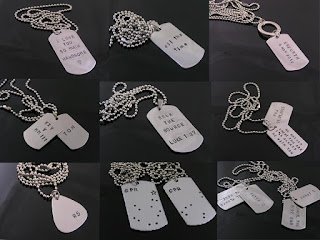
Personalized Dog Tag Necklaces - Great Gift Idea

Shop for Personalized Dog Tag Necklaces Now
 Dog tag necklaces are very versatile and therefore very popular. They come in lots of shapes and metal options (see photo below) and can be stamped with text, numbers, star sign constellation and other symbols.

Several can be worn at once, longer or shorter chains are available.

Monday, May 23, 2016

Brooches - Handmade with your Choice of Gemstone

 Madeira Citrine Brooch
I have made a batch of brooches, showcasing different gemstones and glass beads. Some brooches are abstract, others have a flower design and the large, oval silver one has some flowery, celtic design.

Every design can be made with your choice of gemstone or glass stone.

A different way to accessorize a plain top and great to combine with earrings or a bracelet.

Sunday, May 22, 2016

What you pay is what you get...

I love this photo.
It so nicely demonstrates what happens when people ask for cheaper and cheaper work. Quality has it's price.

Saturday, May 14, 2016

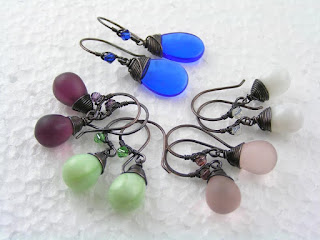
Wire Wrapped Earrings, Handmade Jewelry

 Matte Pink and Black Earrings

 Sapphire Blue Earrings
Turning wire and beads into signature earrings. This is solid copper wire, formed, hammered and wire wrapped. The finished earrings are oxidized and then tumble polished to achieve the dark gray colour. These are available in a large range of colors and metal finishes.
 Matte Purple Drop Earrings

Monday, March 28, 2016

Classic Jewelry

Genuine gemstones, wire wrapped to solid stainless steel necklaces, Great affordable gift idea.

Sunday, March 20, 2016

Art Nouveau Brooch

For anyone interested in antique jewelry:

This one is a handmade art nouveau style brooch (made somewhere around 1905 give or take a couple of years).

It is made in a simple wire design (9ct gold) and set with two garnet topped doublets as flowers.

The garnet topped doublet was popular in the 18th and 19th century and used in Victorian and Edwardian jewelry.  Once it was discovered that glass fuses easily with garnet, this technique was used to imitate ruby, sapphire, emerald and other colored gemstones. The top, (crown) was garnet, the bottom (pavilion) was green, blue, or red glass, an optical illusion, only the color of the bottom layer shows- the garnet provides no color, but since garnet is much harder than glass, these composite stones last much longer compared to simple paste (glass).

Friday, March 11, 2016

Coral - Colors, Facts and Lore

Facts about Coral
Coral is more popular than ever for jewellery, despite trade and harvesting regulations related to the importance of this creature to the ecosystems of the world. Here is some information about coral, including a description of different colours, coral care, and some coral lore.
 

Basic Coral Facts

Coral is an organic gemstone derived from the skeletons of a marine animal related to jellyfish and anemones. Coral polyps live in colonies and some types of coral form reefs, which are home to approximately 25% of the species in the ocean. Coral is composed primarily of calcium carbonate and gets it colour from natural pigments such as carotene. Coral is not used fresh from the ocean, but goes through a series of processing steps before it is used for jewellery. These steps may include chemical treatment, tumbling, heating, sawing, and polishing.

Colors of Coral

In addition to coral substitutes, which include plastic, glass, and seashell, genuine coral is often dyed to resemble a more rare or desired variety. However, natural coral that is suitable for jewelry is found in many colors:

Black Coral

Antipathes grandis
Black coral is rare. When it has been polished it shines with an incredible luster. Some black coral may be coral in an early stage of decay, since it is found just below the water's surface. However, Hawaiian black coral is found at depths exceeding 200 feet! A colony of Hawaiian black coral requires 50 years to mature.
P7230003-1-1.jpg

Blue Coral

Allopora subviolacea, Allopora akori
Blue coral is found near the water's surface and is believed to be coral in an early state of decay.P7230001.jpg

Golden Coral

Golden coral is found off of Hawaii. It has a resinous or lacquered appearance.


Pink Coral

Corrallium secundumPink coral is very dense and relatively hard. Its colour runs the entire spectrum of pinks, from almost white to pink to nearly red. Natural marbling and colour gradations in larger pink corals are natural qualities of the gem. All shades of pink coral are highly prized. Pink coral is sometimes called angel skin coral.


Red Coral

Corallium japonicum, Corallium rubrum, Corallium nobileRed coral is highly valued for its hardness, beauty, and colour. Red coral is found in several places, including the sandy bottom of the Mediterranean, around the Hawaiian Islands, and off the coast of Africa. Hawaiian red coral is found at ocean depths of 500-1,000 feet. Red coral only grows about 1/4 inch per year!
P7230005-1-1.jpg  P7230007-1_edited-1.jpg 

The primary colors of precious coral are red (Sardinian), dark purplish oxblood red, salmon (peach), pink, angelskin, white and blush. SOLID salmon or dark peachy pink is Sciacca, and SOLID pink is angelskin. This last one deviates from the origin of the name angelskin, which refers to the more white colour with a uniform pink hue. These SOLID colors (Sardinian, Sciacca, Angelskin) along with SOLID white (Ionian Sea and VERY, VERY rare as the lack of light to achieve pigmentation is only found at extreme depths) are the most precious and valuable corals in the world. Blush and other variations can also be precious coral (primarily if they are Mediterranean), although not quite as valuable as solid colors, but still investment grade, durable and beautiful. P4190001_edited-1.jpg
The photo shows, from left to right, white, pink, salmon and oxblood coral, plus an angel skin coral cameo (framed by tiny natural pearls).

Caring for Coral

Coral is a very soft gemstone, so it needs to be treated gently. Clean coral jewellery by wiping it gently with a moist soft cloth. Because it is naturally porous, coral can be damaged by exposure to chemicals such as perfumes and hair styling aids. When not being worn, coral should be stored carefully to avoid scratches. If your Coral starts to get dry or as a prevention, wipe with baby oil once a year. Let it soak in for a day and wipe all residue off.

Coral Lore

Many myths and legends surround coral. Coral artifacts have been found from as long ago as 10,000 B.C. Many special properties are attributed to it:
Coral is one of the seven treasures listed in Buddhist scriptures.
Coral was thought to be able to calm the sea.
Coral was believed to protect from lightning and hurricanes.
Coral was worn as a talisman to stop bleeding.
If the wearer of coral became seriously ill, it was believed the coral would lose its colour.
Ancient Romans would put coral around the necks of their children to protect them from harm.
Pulverized coral added to wine was believed to be a potent curative tonic (Ancient Rome).
In Medieval times, coral was used to ward off the evil eye and to cure sterility.
Italian men once presented coral as an engagement gift.

Source: Facts about Coral, Wedunit Jewels